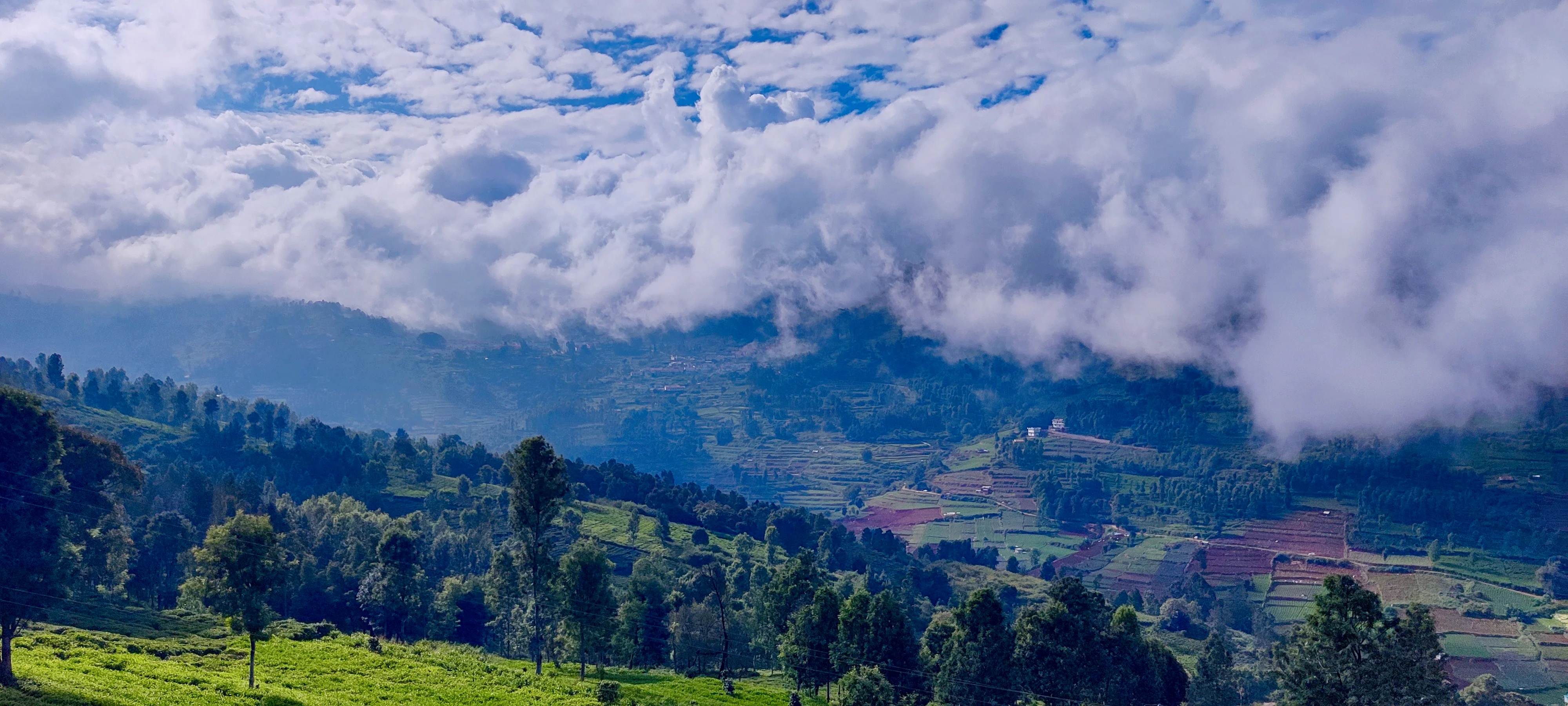
Nilgiris Weather & Travel Intelligence
Real-time satellite forecasts, elevation microclimates (Ooty, Coonoor, Kotagiri, Gudalur & Masinagudi), month-by-month climate datasets, seasonal packing lists, safari schedules, and road safety advisories.

Select Your Nilgiris Town
Ooty / Udhagamandalam
High Plateau & Cool Shola Valleys
Partly Cloudy · Pleasant
Crisp morning air and mild afternoon conditions. Ideal for morning viewpoints (Doddabetta & Tea Gardens) before 1:00 PM. Carry a light windbreaker for evening breezes.
Quick Answers: Current Nilgiris Weather
Direct answers to the most common traveller questions before starting your drive.
Is it raining in Ooty right now?
Check the live radar above. Mornings between October and April are typically dry and sunny; showers occur mostly during afternoon convective periods or monsoon months (June–August).
Does it snow in Ooty?
No, Ooty never gets snowfall. What visitors see in winter (Dec–Jan) is heavy ground frost formed when valley temperatures drop below 0°C at night.
Is Ooty cold right now?
Ooty averages 12°C–22°C year-round. Even in summer, evenings drop to 10°C–12°C. Always pack a jacket regardless of the month you travel.
Is today good for Doddabetta?
Visit before 11:00 AM. High summit viewpoints (2,637m) regularly cloud over after midday due to rising mountain thermal mist.
The Best Time to Visit Ooty Depends on What You Want
Why simplistic "Best Month" claims are misleading in a diverse mountain terrain.
For Pleasant Weather & Gardens
Daytime temperatures of 20°C–25°C offer the perfect relief from the South Indian plains heat. Botanical and Rose Gardens are meticulously curated for the annual May Horticultural shows.
For Cold Weather & Crisp Skies
Crystal-clear blue skies, 10+ km panoramic mountain visibility, starry nights, and dawn ground frost in valley meadows (Wenlock Downs). Night temperatures regularly dip to 2°C–6°C.
For Mist, Rain & Roaring Falls
Rolling monsoon fog, emerald tea slopes washed in rain, roaring Pykara waterfalls, and cozy heritage bungalow stays by a fireplace. Lowest accommodation tariffs of the year.
For Mudumalai Wildlife Safaris
Dry season in Mudumalai and Masinagudi thins the jungle brush and concentrates Asian elephants, Indian gaur, and deer herds near the Moyar riverbed and perennial waterholes.
For Landscape Photography
Post-monsoon transition gives you deep green Shola valleys, wildflower blooms on 9th Mile meadows, dramatic cloud shadows, and crystal-clear mountain horizons between brief showers.
For Family & Senior Holidays
Mild daytime warmth, dry paths for walking through Sims Park and Botanical Garden, comfortable toy train rides, and manageable traffic outside peak holiday weekends.
Month-by-Month Nilgiris Climate Master Table
Statistical 30-year climatological averages for Ooty, Coonoor, Kotagiri, Gudalur, and Masinagudi.
| Month | Ooty Day | Ooty Night | Rain (mm) | Rain Days | Coonoor Day | Kotagiri Day | Gudalur Day | Masinagudi Day | Crowd | Wildlife |
|---|---|---|---|---|---|---|---|---|---|---|
| January | 20°C | 5°C | 15 mm | 1 d | 23°C | 22°C | 27°C | 30°C | High | Very High |
| February | 22°C | 6°C | 12 mm | 1 d | 24°C | 23°C | 28°C | 32°C | Moderate | Very High |
| March | 24°C | 8°C | 25 mm | 2 d | 26°C | 25°C | 30°C | 34°C | Moderate | Very High |
| April | 25°C | 11°C | 75 mm | 5 d | 27°C | 26°C | 31°C | 36°C | Very High | High |
| May | 25°C | 12°C | 145 mm | 9 d | 27°C | 26°C | 31°C | 36°C | Very High | High |
| June | 18°C | 11°C | 280 mm | 18 d | 21°C | 20°C | 26°C | 32°C | Moderate | Low (Rain) |
| July | 17°C | 11°C | 350 mm | 22 d | 20°C | 19°C | 25°C | 30°C | Low | Low (Rain) |
| August | 17°C | 11°C | 260 mm | 19 d | 20°C | 20°C | 25°C | 30°C | Moderate | Moderate |
| September | 19°C | 10°C | 180 mm | 13 d | 22°C | 21°C | 27°C | 31°C | Moderate | High |
| October | 20°C | 10°C | 210 mm | 14 d | 22°C | 21°C | 27°C | 31°C | High | High |
| November | 19°C | 8°C | 140 mm | 9 d | 22°C | 21°C | 27°C | 30°C | Moderate | Very High |
| December | 19°C | 5°C | 45 mm | 3 d | 21°C | 21°C | 26°C | 29°C | Very High | Very High |
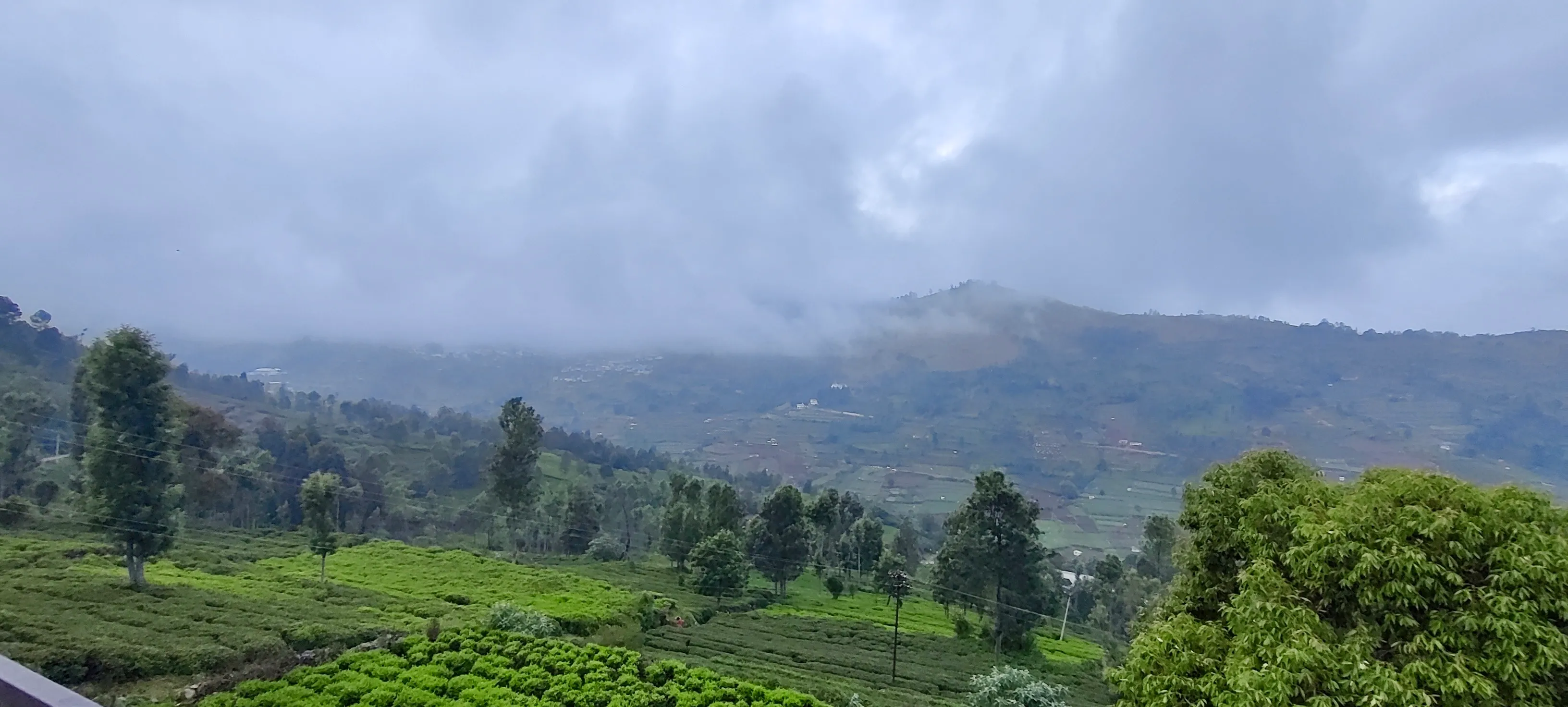
Nilgiris in Late September: Post-Monsoon Emerald Clarity
Photographed from our family estate slopes in Thuneri village after the southwest monsoon rains taper off.
Ooty vs Coonoor vs Kotagiri vs Gudalur vs Masinagudi
Why the Nilgiris has 5 completely different weather systems within a 35 km radius.
Ooty / Udhagamandalam
High Plateau & Cool Shola Valleys
The coolest major town in Tamil Nadu. High elevation creates crisp morning chill, frequent cloud cover, and rapid weather shifts from bright sun to heavy mist in minutes.
Coonoor
Milder Tea Garden Slopes
Located 390m lower than Ooty. Averages 3°C to 5°C warmer than Ooty with gentler winds, lush tea terraces, and slightly higher rainfall during the Northeast Monsoon.
Kotagiri
Temperate Climate & Quiet Ridges
Historically recognized for having the most equitable microclimate in the Nilgiris. Sheltered from extreme southwest monsoon gales while remaining far less commercial than Ooty.
Gudalur
Lush Rain-Belt Gateway
Perched on the western slopes bordering Wayanad and Mudumalai. Receives heavy southwest monsoon rainfall, maintaining tropical rainforest vegetation and distinctly warmer temperatures.
Masinagudi / Mudumalai
Warm Rain-Shadow Wildlife Plains
Lies in the rain-shadow foothills on the northern slope. Dramatically hotter and drier than Ooty. Even when Ooty is freezing in dense mist, Masinagudi can be sunny, dry, and warm.
Is Masinagudi Hotter Than Ooty?
Yes, substantially hotter by 10°C to 15°C. Masinagudi sits at 900m altitude in the northern rain-shadow foothills beneath the Nilgiri plateau. In summer (April–May), Masinagudi reaches 34°C–37°C while Ooty is 22°C–25°C. When Ooty is shivering in cold monsoon rain (July), Masinagudi is often completely dry and sunny because the high mountain wall blocks southwest monsoon clouds.
The 4 Nilgiris Seasons in Detail
How the hills change across Summer, Monsoon, Post-Monsoon, and Winter.
Summer Season
The peak holiday season in the upper Nilgiris. Crisp sunny mornings give way to comfortable afternoons and cool 10°C–12°C evenings. The Government Botanical Garden, Rose Garden, and Sim’s Park host world-famous floral and fruit exhibitions in May.
What to Pack: Light cotton daywear, light jacket or fleece for night, sunscreen, sunglasses, and a compact umbrella for May showers.
What to Avoid: Travelling without pre-booked hotels or e-passes; assuming you won't need warm layers at night.
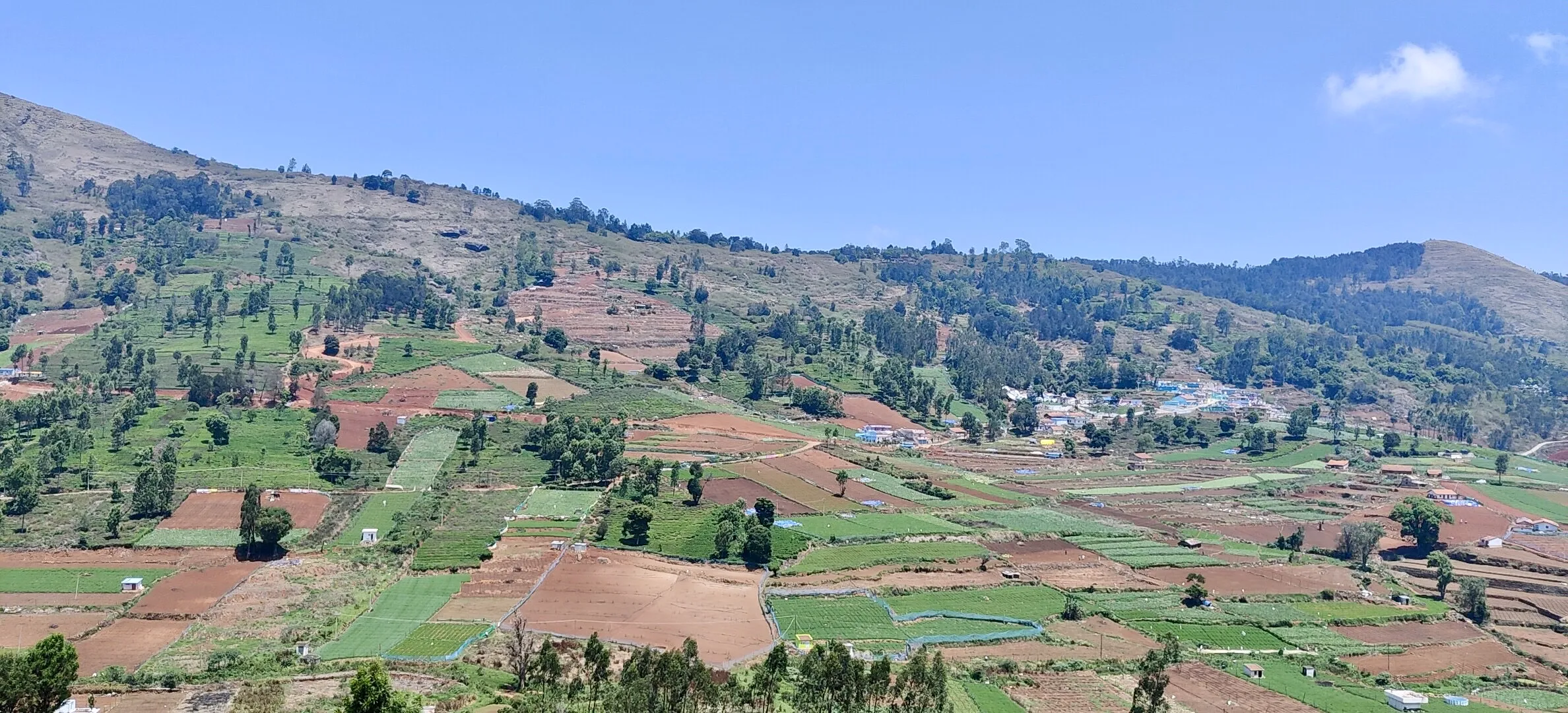
Agricultural terraces in summer near Thuneri village.
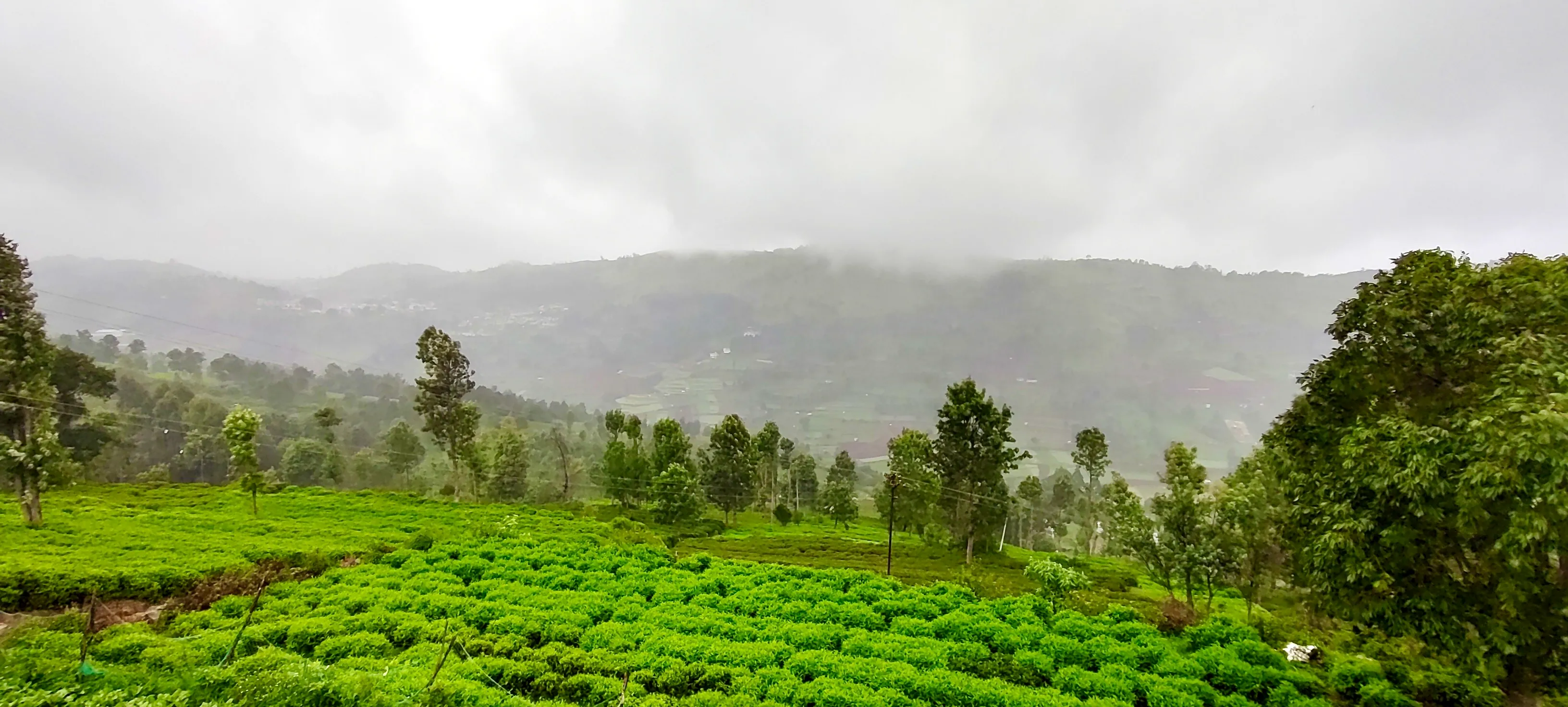
Dense southwest monsoon cloud cover rolling over the tea estates.
Southwest Monsoon
The Nilgiris transforms into a breathtaking emerald landscape. Rains peak in July (350mm), filling the waterfalls (Pykara, Catherine, Kalhatty) to full fury. Dense mist envelops the hills, creating an intensely romantic, quiet atmosphere.
What to Pack: High-grade waterproof jacket/poncho, footwear with aggressive rubber grip, spare dry socks, windproof umbrella.
What to Avoid: Climbing slippery moss-covered rocks at waterfalls, speeding down wet hairpin curves, driving in night fog.
Winter Season & Valley Frost
Sunny, dry, and crisp by day (19°C–22°C); freezing cold at night. In open valleys like Wenlock Downs (9th Mile) and Avalanche, nocturnal radiative cooling causes ground frost (frozen dew) to carpet the grass in white.
What to Pack: Heavy woolen jacket or down coat, thermal base layer, beanie/cap, gloves, thick socks, moisturizer.
What to Avoid: Expecting snowfall (it is frost, not snow); booking budget homestays without confirming geyser/hot water supply.
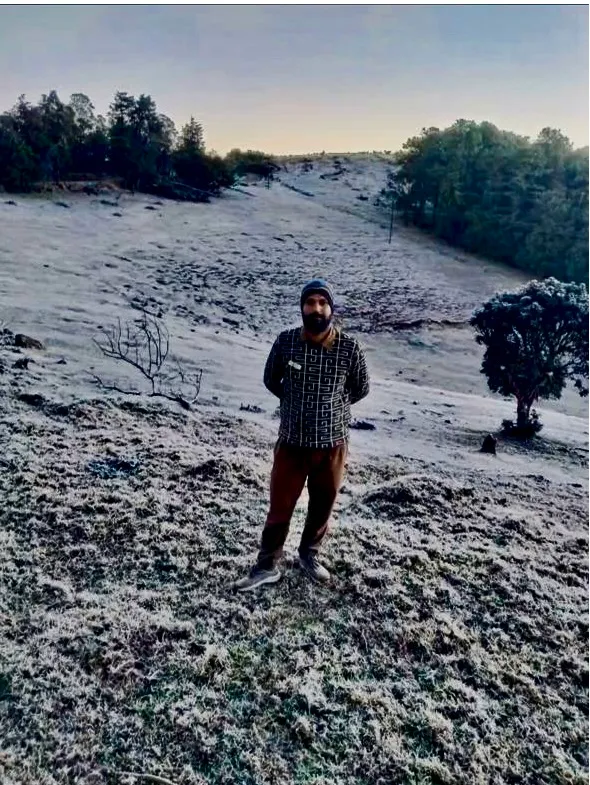
Ground frost blanket on winter morning grass in our village valley.
Wildlife & Weather: Best Time to See Animals
Mudumalai Tiger Reserve, Theppakadu Elephant Camp, and Masinagudi scrub plains.
Visibility & Sighting Index
⭐⭐⭐⭐⭐ (Highest visibility of the year)
Asian Elephants: High (Elephants congregate near Moyar River and Theppakadu riverbanks)
Indian Gaur (Bison): Very High (Large herds grazing on open meadows in early mornings)
Predators (Tiger/Leopard): Moderate to High chance of Leopard and Tiger trail tracks near riverbeds (sightings unpredictable)
Safari Comfort: Excellent (Crisp morning air, dry roads, no leech nuisance)
Visibility & Sighting Index
⭐⭐⭐⭐⭐ (Excellent line of sight through thin brush)
Asian Elephants: Very High (Frequent sightings along forest roads and water points)
Indian Gaur (Bison): High (Move deeper toward shaded valley bottoms by midday)
Predators (Tiger/Leopard): Higher movement around dwindling waterholes in late afternoons
Safari Comfort: Warm to Hot (32°C–36°C in Masinagudi noon; book early 06:30 AM slots)
Visibility & Sighting Index
⭐⭐⭐ (Challenging due to thick green foliage)
Asian Elephants: Moderate (Herds disperse across broader forest landscape)
Indian Gaur (Bison): High (Thriving on fresh green grass flushes)
Predators (Tiger/Leopard): Low probability of sighting due to thick brush and dispersed prey
Safari Comfort: Wet & Humid (Expect sudden rain squalls; vehicles have open sides or canopies)
Visibility & Sighting Index
⭐⭐⭐⭐ (Clear crisp post-rain atmospheric conditions)
Asian Elephants: High (Family herds with young calves grazing peacefully)
Indian Gaur (Bison): Very High (Healthy herds in prime condition)
Predators (Tiger/Leopard): Moderate (Active during crisp mornings and late twilight)
Safari Comfort: Very Good (Pleasant temperatures, clear skies between occasional showers)
🐘 Theppakadu Elephant Camp & Forest Etiquette
Nilgiris Annual Festivals & Shows
Sacred Badaga traditions, Government horticultural exhibits, and town festivals.
Ooty Flower Show (Annual Summer Festival)
The premier horticultural spectacle in India, dating back over 125 years. Features hundreds of thousands of potted exotic blooms, massive floral sculptures, and competitive garden exhibits.
Visitor Etiquette: Arrive early at 07:30 AM before tourist buses clog garden gates. Do not touch or pluck floral arrangements.
Hethai Habba (Sacred Badaga Festival)
The most sacred and deeply revered cultural celebration of the indigenous Badaga community, honoring ancestral deity Goddess Hethai. Thousands of community members clad in pristine white traditional attire (Seelai / Thundu) walk miles to sacred temples.
Visitor Etiquette: This is a deeply sacred cultural and religious observance, NOT a tourist spectacle. Visitors must maintain solemn respect, wear modest clothing, refrain from intrusive photography of rituals or devotees without permission, and strictly avoid consuming non-vegetarian food or alcohol in the sacred village precincts.
Ooty Rose Show
Showcases over 20,000 varieties of roses in full bloom across terraced slopes, featuring creative rose petal rangolis and floral towers.
Visitor Etiquette: Follow one-way walking ramps on terraces; protect children from thorny bushes.
Coonoor Fruit Show
Held in the historic 1874 Sim’s Park botanical garden. Features fruit sculptures made from tons of fresh locally grown Nilgiri plums, peaches, pears, and tropical fruits.
Visitor Etiquette: Park vehicles in designated municipal transit grounds near Coonoor railway station and use shuttle cabs.
Kotagiri Vegetable Show
Kicks off the Nilgiris Summer Festival. Features intricate structures crafted entirely from exotic hill vegetables like carrots, beets, broccoli, and capsicums.
Visitor Etiquette: Family-friendly atmosphere with lesser congestion than Ooty Flower Show.
Gudalur Spice Show
Showcases organic spices cultivated on the Western Ghat slopes (cardamom, pepper, cinnamon, clove, vanilla) with exhibits and direct farmer sales.
Visitor Etiquette: Excellent spot to buy authentic, unadulterated high-grade whole spices directly from registered growers.
Maari Habba (Village Guardian Deity Festival)
Sacred village cleansing and protective festival seeking blessings for agricultural abundance and health. Features traditional Badaga community circle dances, folk music, and communal feast (Oota).
Visitor Etiquette: Village festivals are community gatherings. Non-residents must be invited or accompanied by local hosts. Dress modestly and show deep cultural courtesy.
Road Conditions, Night Ban & Safety
Crucial highway timings and safety advisories verified for 2026 travel.
Bandipur Night Travel Ban (9:00 PM – 6:00 AM)
Highway NH 766 / NH 181 through Bandipur and Mudumalai Tiger Reserve is strictly closed to all private vehicles from 9:00 PM to 6:00 AM. Gates at Melukamanahalli and Kakkanalla slam shut at 9 PM sharp. If driving from Bangalore, ensure you pass Gundlupet before 8:30 PM.
Kalhatty–Masinagudi 36-Hairpin Downhill Restriction
Due to frequent brake failures on the steep 14% incline, police checkposts prohibit non-local outstation vehicles from driving downhill via Kalhatty to Masinagudi. All tourists returning toward Bangalore/Mysore must take the wide, gentle Gudalur highway (NH 181).
Frequently Asked Questions
Direct answers to 40+ high-intent queries on Nilgiris weather, temperatures, packing, and road rules.
What is the weather in Ooty today and how cold is it right now?
Ooty typically ranges from 12°C to 20°C during the day and drops between 5°C and 11°C at night depending on the season.
Upper Nilgiris (2,240m elevation) maintains a cool temperate montane climate. Daytime temperatures rarely exceed 25°C even in peak summer (May), while winter nights (December–January) regularly drop to 1°C–5°C with frost forming in open valleys.
Is it raining in Ooty right now?
Check our live weather hero at the top of this page for real-time precipitation radar and hourly rain forecasts.
Rainfall in Ooty is seasonal. The heaviest rains occur during the Southwest Monsoon (June to August), while mornings between December and March are almost universally dry and sunny. Afternoon convection showers can occur between April and May.
Does Ooty ever get snowfall?
No. Ooty does not experience snowfall under any normal meteorological circumstances.
Because Ooty is situated in the tropical latitudes of South India (11°N), the upper atmosphere is not cold enough for snow crystals to form. However, during December and January, nocturnal radiative cooling causes ground temperatures in valleys (like Wenlock Downs and Avalanche) to drop below 0°C, producing thick white blankets of ground frost (frozen dew) that tourists frequently mistake for snow.
What is the difference between frost and snow in Ooty?
Snow falls from clouds as ice crystals; frost freezes from ground moisture and dew on clear, freezing nights.
On clear, windless winter nights in Ooty, cold air sinks into valley basins (temperature inversion). Moisture on grass, car roofs, and tea leaves freezes solid into white crystalline frost. When the morning sun rises, it melts within an hour. This is frost, not snowfall.
Which is the coldest month in Ooty?
January is statistically the coldest month in Ooty, with nighttime temperatures frequently plunging to 2°C–5°C.
December and January record the lowest minimum temperatures. Valley floors and tea hollows in Avalanche, Emerald, and 9th Mile frequently record sub-zero temperatures (0°C to -2°C) during early dawn hours before sunrise.
Which is the rainiest month in Ooty?
July is the wettest month in Ooty, averaging around 350 mm of rainfall and 22 rainy days.
The peak Southwest Monsoon batters the western ridges of the Nilgiris throughout July. Gudalur and Avalanche receive even heavier downpours than Ooty town. If you visit in July, expect persistent drizzle, dense mist, roaring waterfalls, and limited long-distance viewpoint visibility.
What is the absolute best time to visit Ooty?
The best time depends on your preference: October to March for clear views and cold weather; May for the Flower Show; July to September for lush green mist.
There is no single 'best month.' For crystal-clear mountain views, bright sunshine, and crisp cold nights, visit between October and March. For vibrant botanical exhibits and summer festival events, choose May. For quiet tea estate stays, mist, and roaring waterfalls without crowds, choose July–September.
Is May a good time to visit Ooty?
May is famous for the Flower Show and pleasant 20°C–25°C weather, but it is also the most crowded and expensive month.
May hosts the annual Nilgiris Summer Festival, including the 125+ year-old Ooty Flower Show. While the garden displays are spectacular and the hill climate provides a welcome escape from scorching plains, expect severe traffic jams around town, hotel tariffs at peak surges, and crowded viewpoints.
Is July a good time to visit Ooty?
July is ideal if you love heavy monsoon mist, waterfalls, and peaceful tea estates, but poor for clear viewpoint sightseeing.
July brings the peak of the Southwest Monsoon. Doddabetta Peak is often in a complete cloud whiteout. However, waterfalls like Pykara and Catherine are at peak fury, the tea plantations are intensely green, room rates are heavily discounted, and there are virtually zero tourist queues.
Is October a good time to visit Ooty?
Yes, October is one of the most scenic months, with washed-clean greenery, blooming flowers, and crisp air.
Following the heavy southwest monsoon, the Nilgiri hills are at their greenest in October. Note that the Northeast Monsoon brings afternoon and evening showers to eastern slopes like Coonoor and Kotagiri, but mornings are generally sunny and crisp.
Is December a good time to visit Ooty?
December is wonderful for winter charm, clear skies, morning frost, and festive atmosphere, though Christmas week is very busy.
December offers clear azure skies with 10+ km visibility from peaks like Doddabetta and Dolphin’s Nose. Days are pleasant (19°C) and nights are chilly (5°C). The period between December 22 and January 2 sees massive tourist footfall for year-end holidays.
What should I pack for Ooty in summer (March to May)?
Pack light cotton clothing for daytime, a light jacket or sweater for evenings, sunglasses, sunscreen, and an umbrella.
Although daytime temperatures reach 23°C–25°C in town, night temperatures drop to 10°C–12°C. High-altitude UV rays are intense, making sun protection essential. Afternoon thunder showers in late April/May make a compact umbrella useful.
What should I pack for Ooty in winter (December to February)?
Pack heavy woolen coats or padded jackets, thermal inners, woolen beanies, gloves, thick socks, and moisturizing cold cream.
Night temperatures drop close to freezing (1°C–5°C). If you plan early morning visits to Wenlock Downs or Doddabetta, thermal inners, a windproof outer jacket, and warm ear coverings are mandatory to stay comfortable.
What should I pack for Ooty during monsoon (June to September)?
Pack a waterproof hooded jacket or poncho, sturdy footwear with rubber grip, a wind-resistant umbrella, and extra dry socks.
Ordinary cotton shoes soak through quickly and dry very slowly in high hill humidity. Pack water-resistant sneakers or trekking boots, a reliable rain poncho, a waterproof phone pouch, and a power bank.
Do I really need a jacket in Ooty during summer?
Yes, you definitely need a light jacket or cardigan even in peak summer.
While you will be comfortable in a t-shirt at 1:00 PM in the sun, temperatures drop sharply after sunset (6:30 PM) to 10°C–12°C. Mountain breezes at high viewpoints like Doddabetta and Pykara also feel chilly year-round.
Do I need thermal inners in Ooty?
Thermals are highly recommended for winter visits (Nov–Feb), especially for elderly travellers, young children, and late-night strolls.
Most budget homestays and cottages in Ooty do not have central heating. Thermal base layers keep you warm inside unheated rooms and during early morning 06:30 AM viewpoints before the sun warms the air.
Is Coonoor colder than Ooty?
No. Coonoor is at 1,850m elevation (390m lower than Ooty) and is typically 3°C to 5°C warmer than Ooty.
Coonoor has a milder, more sheltered climate than Ooty. If Ooty is 18°C and foggy, Coonoor is often 22°C with broken clouds. It is an excellent base for travellers who find Ooty's winter chill or heavy monsoon too intense.
Is Kotagiri drier than Ooty?
Kotagiri is sheltered from the severe brunt of the Southwest Monsoon, making it generally drier between June and August than Ooty.
Because Kotagiri lies on the eastern escarpment, it receives less southwest monsoon rain than western-facing Ooty and Gudalur. However, Kotagiri receives significant rainfall during the Northeast Monsoon (October–November). It is renowned for having the most balanced year-round climate in the district.
Is Gudalur warmer than Ooty?
Yes. Gudalur sits at 1,050m elevation and is 6°C to 8°C warmer than Ooty throughout the year.
Gudalur represents the Western Ghats transition zone bordering Wayanad. It features tropical evergreen spice plantations and high southwest monsoon rainfall (2,800 mm annually), with daytime temperatures often reaching 28°C–31°C.
Is Masinagudi hotter than Ooty?
Yes, by a very large margin. Masinagudi sits at 900m in the rain-shadow foothills and is typically 10°C to 15°C hotter than Ooty.
Masinagudi features dry deciduous scrub forest and low annual rainfall (750 mm). In summer (April–May), Masinagudi daytime temperatures reach 34°C–37°C while Ooty is a comfortable 22°C–25°C. Even in winter, Masinagudi afternoons are sunny and warm (29°C–30°C).
Does it rain in Masinagudi when it rains in Ooty?
Not necessarily. During the Southwest Monsoon (June–August), Ooty can be drenched in rain while Masinagudi remains dry and sunny.
The high Nilgiri mountain ridge blocks rain-bearing southwest monsoon clouds from spilling over the northern slope. This 'rain-shadow effect' keeps Masinagudi and Mudumalai largely dry while Ooty and Gudalur receive hundreds of millimeters of rain just 25 km away.
When is the best time for Mudumalai and Masinagudi wildlife safaris?
December to May is the best period for wildlife viewing, as the dry forest improves visibility and animals gather at waterholes.
During dry months, deciduous trees shed leaves, opening up clear lines of sight through the forest brush. Asian elephants, Indian gaur (bison), spotted deer, and wild boar congregate along the Moyar River and forest watering holes. Early morning (06:30–09:00 AM) and late afternoon (03:30–06:00 PM) safaris offer the highest sighting probabilities.
When are wild elephants easiest to spot near Ooty?
Wild elephants are most frequently spotted in the Mudumalai Tiger Reserve and Masinagudi corridor between January and May.
As water sources dry up in the interior forest, elephant herds move toward the perennial Moyar riverbed, Theppakadu riverbanks, and major reservoir borders. Sightings in the wild are never guaranteed, but probabilities are highest during the dry season.
Can I see tigers in Mudumalai Tiger Reserve?
Mudumalai has a healthy tiger population, but sightings by tourists on standard safaris are rare and unpredictable.
Tigers are solitary, nocturnal, and highly elusive apex predators that stay in dense core jungle terrain. While pugmarks and alarm calls from deer and langurs are common on safaris, direct sightings depend purely on chance and luck. Never trust operators promising 'guaranteed tiger sightings.'
Are wildlife sightings guaranteed on forest safaris?
No. Wildlife sightings in government tiger reserves are never guaranteed under any circumstances.
Animals roam freely across hundreds of square kilometers of protected wilderness. Sightings depend on forest weather, animal movement patterns, noise levels, and seasonal water availability. Approaching a safari with patience and enjoying the overall forest ecology ensures the best experience.
When is the famous Ooty Flower Show held?
The Ooty Flower Show is held annually in mid-to-late May for 5 days at the Government Botanical Garden.
Organized by the Tamil Nadu Department of Horticulture, the Flower Show represents the grand climax of the Nilgiris Summer Festival. Exact dates are officially announced by the District Collectorate in April each year.
When is the Ooty Rose Show held?
The Rose Show takes place in the second week of May at the Government Rose Garden on Elk Hill.
Held a week before or concurrently with the main Flower Show, this event showcases over 20,000 rose cultivars in peak bloom with elaborate petal rangolis and competitive exhibits.
What is Hethai Habba and when is it celebrated?
Hethai Habba is the most sacred cultural festival of the indigenous Badaga community, celebrated in December or January.
Celebrated on the 8th day after the new moon in the traditional Badaga month of Hethai (lunar calendar), this sacred observance honors Goddess Hethai. Community members clad in traditional white garments participate in sacred walks to the ancestral shrine at Beragani. It is a living sacred tradition that warrants deep respect and quiet reverence from visitors.
What is Maari Habba in the Nilgiris?
Maari Habba is the traditional village guardian festival observed across Badaga villages between February and April.
Each Badaga hatti (village) celebrates its own Maari Habba on specific dates fixed by village elders. The rituals focus on village health, agricultural prosperity, and protection from summer ailments, accompanied by communal feasts and traditional group dances.
When is Ooty most crowded during the year?
Ooty is most crowded in May (Summer Festival / Flower Show), followed by Christmas–New Year week and festive long weekends.
Peak tourist rushes occur during May weekends, Puja / Dussehra holidays (October), and the last ten days of December. During these periods, expect heavy traffic along Commercial Road, full parking lots at Doddabetta, and premium room tariffs.
When is traffic worst on the Ooty ghat roads?
Traffic peaks on Friday evenings climbing up and Sunday afternoons driving down, especially during May and long holiday weekends.
The Mettupalayam–Coonoor–Ooty ghat road (NH 181) experiences severe slowdowns on holiday weekend mornings. To avoid crawling in 2-hour traffic jams, start climbing from Mettupalayam before 07:30 AM or after 02:00 PM.
What is the Bandipur night traffic ban?
Highway NH 766 / NH 181 through Bandipur and Mudumalai is strictly CLOSED to all private vehicles from 9:00 PM to 6:00 AM every night.
By Supreme Court order to prevent roadkills in the core tiger reserve corridor, forest entry gates at Melukamanahalli (Karnataka) and Kakkanalla (Tamil Nadu) slam shut at 9:00 PM sharp. Vehicles arriving late are turned around back to Gundlupet town. Plan your drive from Bangalore to cross the gate before 8:30 PM.
Are non-local tourist vehicles allowed down the 36-hairpin Masinagudi road?
No. The steep Kalhatty–Masinagudi ghat (36 hairpin bends) is strictly restricted for downhill descent by outstation tourist vehicles.
Due to severe fatal brake failures on the steep 14% gradient, police checkpoints prohibit non-local outstation vehicles from driving down the 36 hairpins toward Masinagudi. All tourists travelling toward Bangalore/Mysore/Kerala must use the gentle, double-lane Gudalur highway (NH 181).
Is it safe to drive to Ooty during the monsoon?
Yes, provided you drive cautiously in low gear, avoid speeding, check weather advisories, and avoid night driving in dense fog.
The National Highways department maintains active road clearance teams during the monsoon. Use 2nd or 3rd gear for engine braking rather than riding your footbrake, ensure wiper blades and fog lamps are in top condition, and do not attempt mountain driving during severe weather red alerts.
Can I see wild animals roaming inside Ooty town center?
No. Wild elephants and tigers do not enter Ooty town, though Indian Gaur (bison) occasionally wander through suburban tea borders.
Large wildlife like elephants, deer, and tigers inhabit the lower-elevation sanctuary plains of Mudumalai and Masinagudi. Indian Gaur (bison) sometimes graze quietly in tea estate borders around Coonoor, Lovedale, and Kotagiri; always maintain a safe 50-meter distance and never approach them.
Why do viewpoints like Doddabetta sometimes have zero visibility?
Doddabetta stands at 2,637m altitude where passing cloud banks create dense fog whiteouts, especially after 1:00 PM.
During monsoon months and humid afternoons, moisture-laden air rises up the mountain slopes (orographic lifting) and condenses into thick cloud cover around high summits. For the clearest views, visit Doddabetta between 07:30 AM and 10:30 AM before afternoon clouds form.
Is an E-Pass required to visit Ooty?
Yes. The Tamil Nadu government mandates an online E-Pass for all outstation vehicles entering the Nilgiris district.
The E-Pass is 100% free and instantly generated on the official TNeGA portal (epass.tnega.org). It is inspected at all border checkposts (Kallar, Kakkanalla, Nadugani, Kunjappanai) to regulate tourist traffic volumes.
What footwear is best for exploring Ooty?
Sturdy sneakers or walking shoes with rubber grip are essential; avoid high heels and flat slippery sandals.
Sightseeing in Ooty involves walking on sloping botanical garden lawns, damp tea garden dirt trails, and wet stone steps around waterfalls. High-traction closed footwear prevents slips and protects your feet from cold ground temperatures.
How long are the waiting lines at entry checkposts on weekend mornings?
On Friday and Saturday mornings, checkpost verification lines can take 15 to 45 minutes.
To clear checkposts smoothly, keep your E-Pass PDF screenshot and vehicle RC ready on your phone, avoid carrying banned single-use plastic water bottles under 5L, and have ₹20–₹100 cash ready for the municipal Green Tax toll.
Where can I check verified live Nilgiris weather forecasts?
Right here on OotyWeekend's live weather intelligence page, updated hourly with microclimate data from high-resolution meteorological models.
Our platform aggregates live meteorological feeds with local resident field observations, providing distinct forecasts for Ooty, Coonoor, Kotagiri, Gudalur, and Masinagudi alongside road and wildlife advisories.